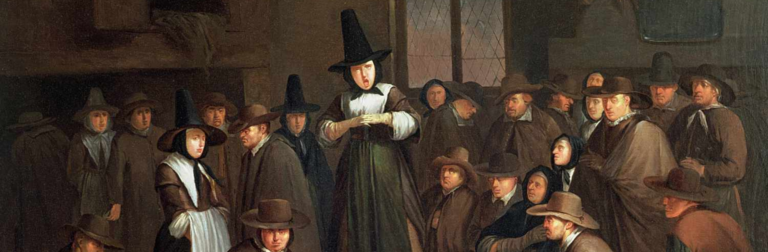
Prophetic Witness

  • Let love be the first motion

    “Love was the first motion, and thence a concern arose to spend some time with the Indians, that I might feel and understand their life and the Spirit they live in, if haply I might receive some instruction from them, or they be in any degree helped forward by my following the leadings of Truth amongst them.”

  • We must do what seems impossible

    “Our witness tells us that we need not wait for nuclear warfare to strike us before we strip our lives of… superfluities; we need not wait for events to bend our wills to unison…. We must simplify our daily routine without waiting for legislation; we must take our political and public responsibilities without having to take the negative action of being ‘against’ nuclear testing, the death-use of science, the military-moulding of education.” 

  • Leadings proceed from a common ground

    “Quakers view truth as something that happens, it occurs…. Truth is not a dead fact which is known: It is a living occurrence in which we participate, the guiding concern of people bearing witness is to live rightly, in ways that are exemplary…. Quakers are convinced that genuine leadings all proceed from a common ground, spring from a unity which we seek and find.”

  • Be a prophet of joy

    “We have often wondered whether there is anything Quakers today can say as one. After much struggle we have discovered that we can proclaim this: there is a living God at the centre of all, who is available to each of us as a Present Teacher at the very heart of our lives. We seek as people of God to be worthy vessels to deliver the Lord’s transforming word, to be prophets of joy who know from experience and can testify to the world, as George Fox did, ‘that the Lord God is at work in this thick night.'”

  • Final writings of a Quaker martyr

    “I heard that New England had made a law to put the servants of the living God to death if they returned after they were sentenced away, which did come near me at that time; and, as I considered the thing and pondered it in my heart, immediately came the word of the Lord unto me, saying, ‘Thou knowest not but that thou mayst go thither.’”

  • To be spiritual is inevitably political

    “To be spiritual requires me to live in such a way that it conflicts with the usual way of doing things, and so it is inevitably political. But not acting at all in the public realm is a vote for business as usual.”

  • The fruit of our alienation

    “Many of us feel a chronic discomfort in American society, much like what young George Fox felt in his time and place. It is a sense of alienation, born of living among people who apparently feel ‘whole and at ease in that condition that was my misery.’ But that misery is the fruit of our own alienation from the witness of God in us. Living closer to that source, we can sense more easily the discomfort of others, whatever appearances they (and we) maintain.”

  • The intensity of Quaker women prophets

    “Katherine Evans, Margaret Killam, and Elizabeth Hooton were emotional, and the intensity of their public voices, which hostile contemporaries described as shouting or screaming, may well have held a residue of personal frustration or exultation; more importantly, it was an expression of the prophet’s ritually expressed anguish over the nation, mediated through the conventional language and behavior of biblical figures.”

  • Does God lead the wicked?

    “Even in the wicked, God has a witness which is pure, which checks them often, though they do not regard it.”

  • We are the most powerful generation

    “Stand up ye prophets of the Lord, for the truth upon the earth; quench not your prophecy, neither heed them that despise it; but in that stand which brings you through to the end. Heed not the eyes of the world, ye prophets of the Lord, but answer that in them all, which they have closed their eye to.”

End of content

End of content